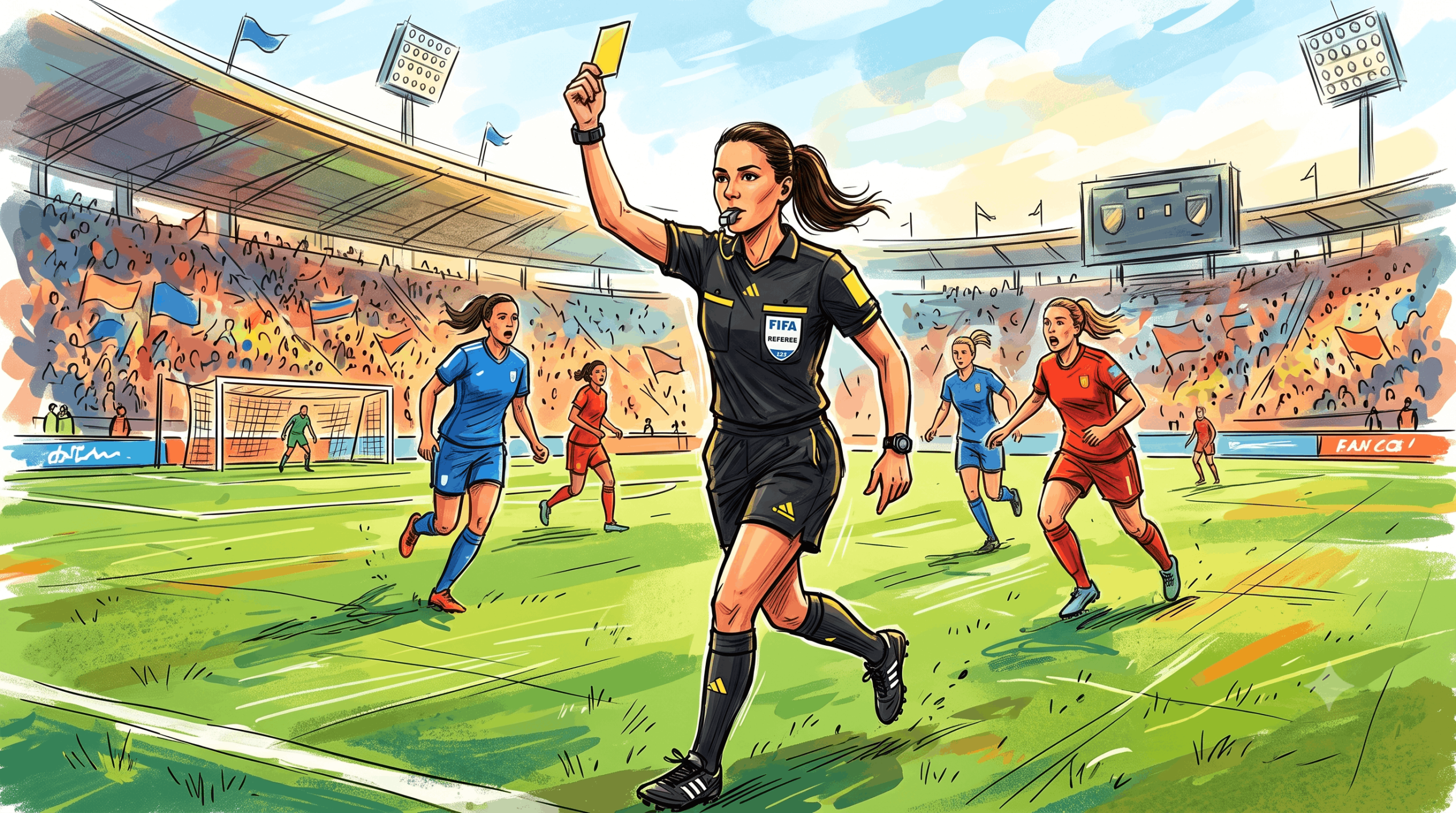
The women who broke into a game that banned them for over 50 years…
Women were banned from registering as football referees in England until 1976. That’s not ancient history — it’s within living memory for plenty of people still involved in the game today. So every name on this list is a genuine first: someone who stepped onto a pitch nobody expected her to be standing on, and made it a little more normal for the next woman to do the same.
Here’s the timeline, and the stories behind each name.
Female Referees Who Made History
A timeline of the milestones that opened the game up.
Wendy Toms — the one who broke the gates open
Long before anyone was talking about Rebecca Welch or Sian Massey-Ellis, there was Wendy Toms. A former Southampton goalkeeper, Toms took up refereeing on a course in Cyprus in the early 1980s and worked her way up through Dorset’s county leagues. In 1991, she became the first woman to officiate in the Football League, working as a fourth official in a Third Division match. She went on to become the league’s first female assistant referee, then made the step up to the Premier League as its first female assistant referee not long after — more than three decades before Rebecca Welch would referee a Premier League match outright.
Toms also refereed at the 2005 UEFA Women’s European Championship and was an assistant official at a Football League Cup final at Wembley. She was, unfairly, dragged into the 2011 Sky Sports sexism scandal — a comment aimed at a different referee was misattributed to her — and has spent the years since mentoring the next generation of officials as a director at Dorset FA.
Sian Massey-Ellis — the one who kept going
Sian Massey-Ellis made her first Football League appointment as an assistant referee in August 2009, aged 23, in a match between Hereford United and Port Vale. She turned professional the following year and took her first Premier League appointment that December, running the line at Sunderland vs Blackpool.
Her second Premier League game brought one of the ugliest moments in this whole story: Sky Sports pundits Andy Gray and Richard Keys were caught making sexist remarks about her competence before kick-off, comments that had nothing to do with her performance and everything to do with her gender. Both men lost their jobs. Massey-Ellis, to her enormous credit, kept officiating — she’s still the highest-ranked female official in English football, was awarded an MBE in 2017, and has since worked at the FIFA Women’s World Cup and men’s Europa League fixtures.
Amy Fearn — first to take the whistle
On 9 February 2010, Amy Fearn became the first woman to referee an English Football League match, stepping in for the final 20 minutes of Coventry City vs Nottingham Forest after the appointed referee was injured. She wasn’t a substitute in the informal sense — once she took over, she was the match official, full stop.
Fearn built on that in 2013, becoming the first woman to referee an FA Cup match in the competition’s main draw. She was awarded an MBE for services to football in 2023, recognising well over a decade at the front of the women’s officiating pathway.
Bibiana Steinhaus — Germany’s trailblazer
Bibiana Steinhaus’s breakthrough happened a continent away, but it matters to this story because of what it proved was possible. In September 2017, she took charge of Hertha BSC vs Werder Bremen to become the first woman to referee a Bundesliga match — not as an assistant, but as the referee in the middle, in one of Europe’s five biggest leagues. Hertha marked the occasion by offering discounted “Bibiana tickets” to female fans.
Steinhaus retired from officiating in 2020 and now serves as FIFA’s Head of Women’s Refereeing, working on exactly the kind of pathway and retention issues — including support for officials returning after having children — that this whole list is really about.
Stéphanie Frappart — a decade of firsts
If one name belongs at the centre of this story, it’s Stéphanie Frappart. The French official became the first woman to referee a Ligue 1 match in 2019, then the first to take charge of a major men’s European fixture when she refereed the UEFA Super Cup between Liverpool and Chelsea that same year. In December 2020, she became the first woman to officiate a men’s Champions League match, taking charge of Juventus vs Dynamo Kyiv.
Then, on 1 December 2022, Frappart made history that reached well beyond football: she became the first woman to referee a match at a men’s World Cup, taking charge of Costa Rica vs Germany at the tournament in Qatar — 92 years after the competition began. She’s since gone on to referee the 2025 Women’s Euro final between England and Spain, and has been named IFFHS World’s Best Woman Referee five times.
Rebecca Welch — closing the gap at home
Rebecca Welch worked as an NHS administrator while climbing the refereeing pathway in her spare time, not turning fully professional until 2019. In 2021, she became the first woman appointed to referee an English Football League match, taking charge of Harrogate Town vs Port Vale in League Two.
The milestones came quickly after that: first woman to referee a men’s FA Cup third-round tie in 2022, first woman to referee a Championship match in January 2023, and then, on 23 December 2023, the one that made headlines everywhere — the first woman to referee a Premier League match, taking charge of Fulham vs Burnley. Burnley manager Vincent Kompany called it a milestone moment at full time. Welch went on to referee the 2024 Women’s Champions League final and the football tournament at the Paris Olympics before retiring from officiating to become PGMOL’s manager of the Select Group Women’s Professional Game.
Why this list matters
None of this happened by accident, and none of it happened quickly. Women were barred from registering as referees in England until the Sex Discrimination Act 1975 forced the FA’s hand a year later. Every name above spent years — sometimes decades — proving themselves in leagues that hadn’t been built with them in mind.
It’s also not finished. England still has only around 3,000 female referees out of roughly 36,000 registered officials, and the FA’s current pathway programmes are explicitly designed to change that ratio. The women on this list are the reason those programmes exist at all — they’re proof it’s possible, which is exactly why their names are worth knowing.