So you can run a decent time 10km but a 90 minute game of football is killing you off? Sound familiar. Maybe it’s time to look at sprint training…
The truth is a hard pill for many grassroots players to swallow: Football isn’t a running sport. It’s an intermittent sprint sport.
While a solid aerobic base is great for general fitness, a steady state jog does very little to prepare your body for the chaotic, explosive reality of a football match at any level. The average sprint in a game lasts just 2 to 4 seconds, but a player will change direction, accelerate, or execute an explosive movement every 5 to 6 seconds.
If you want a real football engine, the kind that makes you feel sharp, dangerous, and electric in the final ten minutes, it’s time to step off the pavement, hold the long jogs and pick up the cones. Let’s go.
1. The Anatomy of a Football Sprint
To train for speed on the pitch, we first need to understand that football speed is entirely different from track speed or from pounding the pavement for 60 minutes at a time. Usain Bolt trains to run in a perfectly straight line, on a flat surface, with no one trying to slide tackle him. Footballers… well, we don’t have that luxury.
Acceleration is King: Top end velocity is great if you’re chasing a long ball into open space, but 90% of football duels are won in the first 0 to 10 yards. The player who reacts quickest and hits their top gear first wins the ball, buys themselves half a yard of space, or blocks the cross.
Multidirectional Movement: You rarely run in a straight line for very long. Football sprints are diagonal, sideways, backward recovery runs and sudden curved arcs to press a defender. Your body needs to be explosive from any stance.
The Braking System (Deceleration): Stopping quickly is just as important as starting. Think about a winger chopping back inside on a dime, or a centre back halting their momentum to intercept a pass. Deceleration requires massive eccentric leg strength. If you don’t train your muscles to absorb that force, you won’t just struggle to lose your marker, you’ll risk injury.
2. The Golden Rules of Speed Training
Before we look at the drills, there is one vital rule to remember: Sprint training is not fitness conditioning.
If you are doing sprints while totally exhausted, crying for air, you are training endurance, not speed. To get faster and sharper, your nervous system needs to be fresh so every single repetition is at 95% to 100% maximum effort.
The 1:5 Work-to-Rest Ratio: If a sprint takes you 4 seconds, you need to rest for at least 20 to 24 seconds before the next one.
Quality Over Fatigue: If your legs start feeling heavy and your pace drops, stop the session. Quality beats quantity every single time. Again, this isn’t an endurance training session.
Train on the Right Surface: If you play on grass or 3G, do your sprint training there. Your muscles, tendons and joints need to adapt to the specific grip and forces of the surface you play on.
3. The Pitch Ready Sprinting Blueprint: 3 Essential Drills
Take these three simple, and easy sprint training drills down to your local park or training pitch.
Drill 1: Pure Acceleration (0 to 20 Yards)
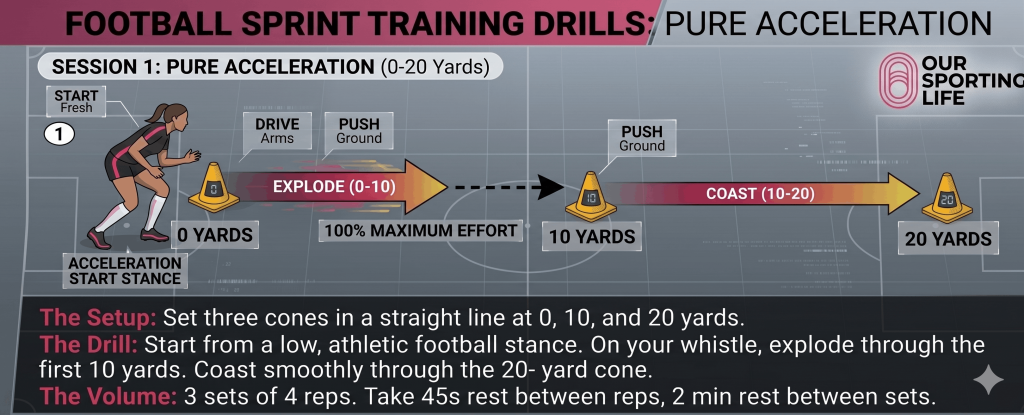
Best done at the very start of a session, right after a thorough warmup when your legs are completely fresh.
The Setup: Set three cones in a straight line at 0, 10, and 20 yards.
The Drill: Start from a low, athletic football stance, leaning slightly forward with your weight on the balls of your feet. On your own mental whistle, explode through the first 10 yards, driving your arms hard and coast smoothly through the 20 yard cone.
The Volume: 3 sets of 4 reps. Take a full 45 seconds of rest between reps, and 2 minutes between sets to let your central nervous system fully recover.
Drill 2: The Deceleration and Cut
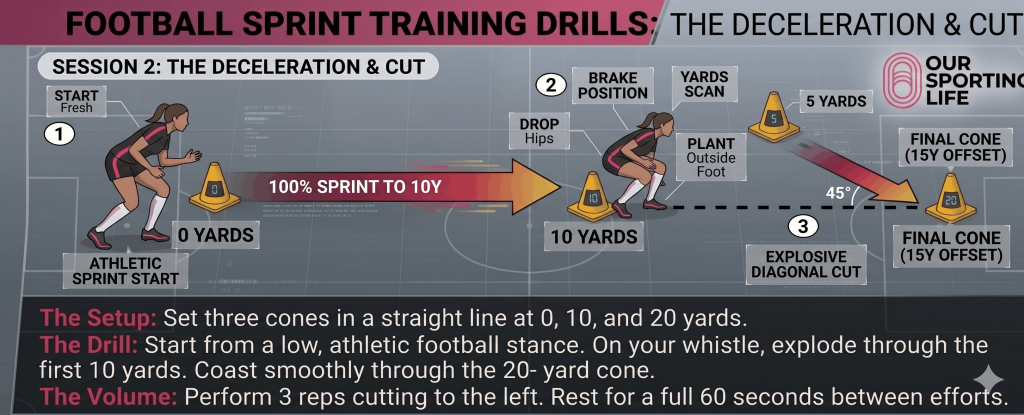
This builds the agility needed to leave defenders behind and trains your knees to handle sudden changes of direction.
The Setup: Place a cone at 0 yards and another at 10 yards. Place a third cone 5 yards further out, but offset to the right at a 45-degree angle.
The Drill: Sprint at 100% effort to the 10-yard cone. Drop your hips low to brake, plant your outside foot firmly, and sharply cut and accelerate diagonally toward the final cone.
The Volume: Perform 3 reps cutting to the right, and 3 reps cutting to the left. Rest for a full 60 seconds between efforts.
Drill 3: Repeated Sprint Ability (The Match Fitness Builder)
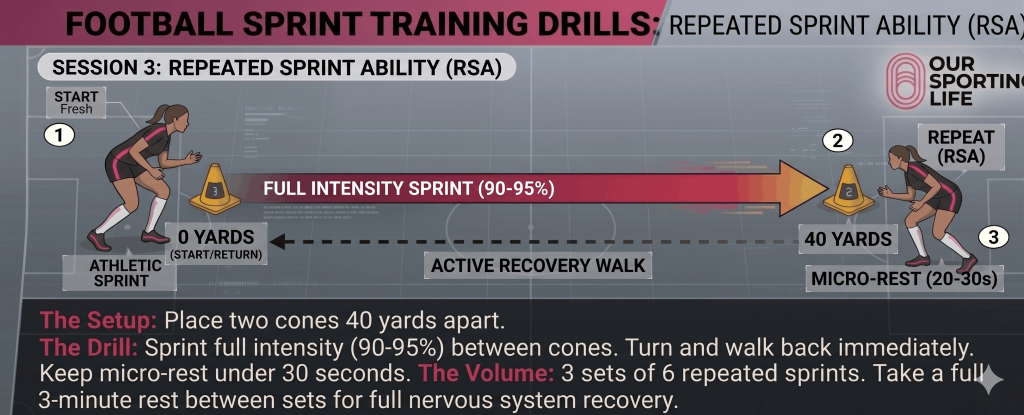
This is the one that builds that late game engine (basically, the aim being to stop you hanging out of your backside into the last 10 minutes of the game). It teaches your body to clear lactic acid and sprint repeatedly on incomplete recovery.
The Setup: Place two cones 30 yards apart.
The Drill: Sprint the 30 yards at roughly 90% of your maximum speed. The moment you cross the line, turn around and walk slowly back to the start. As soon as your foot crosses the starting line, turn and sprint again.
The Volume: 6 sprints equals one block. Perform 2 to 3 blocks total, taking a 3 minute rest between blocks to recover.
4. The Injury Prevention Bonus
There is a massive hidden benefit to sprint training that has nothing to do with the scoreboard: Injury prevention.
High speed running is the ultimate eccentric workout for your hamstrings. When you sprint, your hamstrings have to work incredibly hard to decelerate your lower leg before your foot hits the ground. By exposing your muscles to maximum velocity in a controlled training environment, you essentially vaccinate them against the sudden strains and tears that happen when you try to chase down a striker on match day.
Conclusion: Trade the Pavement for the Pitch
If you want to feel sharp, responsive, and genuinely match-fit, it’s time to evolve your training. Keep one longer run a week if you enjoy the headspace, but swap that second steady-state jog for 20 minutes of high-quality, explosive sprint work.
Your acceleration will sharpen, your recovery times will plummet, and come the 80th minute on Sunday, you’ll be the one speeding past a tired defence while everyone else is running on empty.